

The Unseen Grind: What Olympic Athletes Teach Us About Sustainable Team Performance

We admire Olympic athletes for what we see on the world stage. Precision. Power. Composure under pressure. Record-breaking moments.
But what we see publicly is only the outcome.
The real story lives in the unseen grind - the disciplined routines, the daily repetition, the incremental refinements, and the relentless commitment to improvement over years.
That distinction matters in business.
Because high performance in organizations works the same way.
The Daily Discipline Behind Results
Olympic athletes do not wake up one day ready to win medals. Their success is the product of structured preparation - training cycles, recovery protocols, nutrition strategies, mental conditioning, and constant recalibration.
It is not dramatic. It is consistent.
The discipline lies in the daily work.
In business, we often celebrate results - quarterly revenue, product launches, strategic wins. But like medals, those outcomes are lagging indicators. They reflect work that has already been done.
The question is not only what was achieved. It is how it was built.
Sustainable performance is the result of consistent, disciplined performing.
Monitoring, Feedback, and Real-Time Adjustment
Elite athletes operate within continuous feedback loops. Performance data is reviewed constantly. Coaches and athletes assess technique, endurance, and execution. Adjustments are made in real time.
Training evolves as insight evolves.
In corporate environments, feedback often occurs only once or twice a year. Reviews focus on outcomes rather than the behaviors and processes driving those outcomes. By the time performance issues are visible, the underlying dynamics have already been in motion for months.
Shifting attention toward leading indicators - how teams communicate, collaborate, make decisions, and hold one another accountable - allows for earlier intervention and stronger results.
Performance improves when the process is examined consistently.
Setbacks as Feedback, Not Failure
Athletes expect setbacks. Injuries, losses, and underperformance are treated as data points rather than verdicts. The response is analysis, refinement, and renewed effort.
In professional environments, fear of judgment can suppress experimentation and honest reflection. When mistakes are hidden or avoided, learning slows. Innovation narrows.
A performance culture recognizes that feedback fuels growth. When teams can examine challenges without defensiveness, they accelerate improvement.
Resilience is not accidental. It is practiced.
The Complexity of Team Dynamics
Individual excellence is only part of the equation. In team sports, coordination and cohesion determine outcomes. Trust, communication, and shared accountability transform individual skill into collective strength.
The same applies in business.
High-performing teams require clarity in roles, disciplined decision-making, and distributed ownership. They require trust strong enough to handle challenge and communication precise enough to avoid drift.
Talent without alignment produces inconsistency.
Alignment without accountability produces stagnation.
The unseen dynamics shape visible results.
The Effort No One Sees
It is easy to admire the moment of triumph. What is harder to see are the early mornings, the disciplined recovery, the years of incremental refinement.
In business, growth follows the same pattern.
The late nights refining strategy.
The uncomfortable conversations that strengthen trust.
The process improvements that remove friction.
The learning that accumulates quietly over time.
These efforts compound. They build capability. They prepare teams for visible success.
High performance is rarely dramatic. It is deliberate.
Translating the Athlete Mindset to Business
If Olympic-level discipline were applied consistently in organizations, several shifts would occur.
Teams would examine leading indicators more frequently. They would treat communication breakdowns as correctable technique, not personality flaws. They would refine decision processes before missed targets forced change. They would view accountability as a shared responsibility rather than a leadership burden.
Most importantly, they would recognize that performance is engineered through process, not wished into existence through ambition.
From Analogy to Application
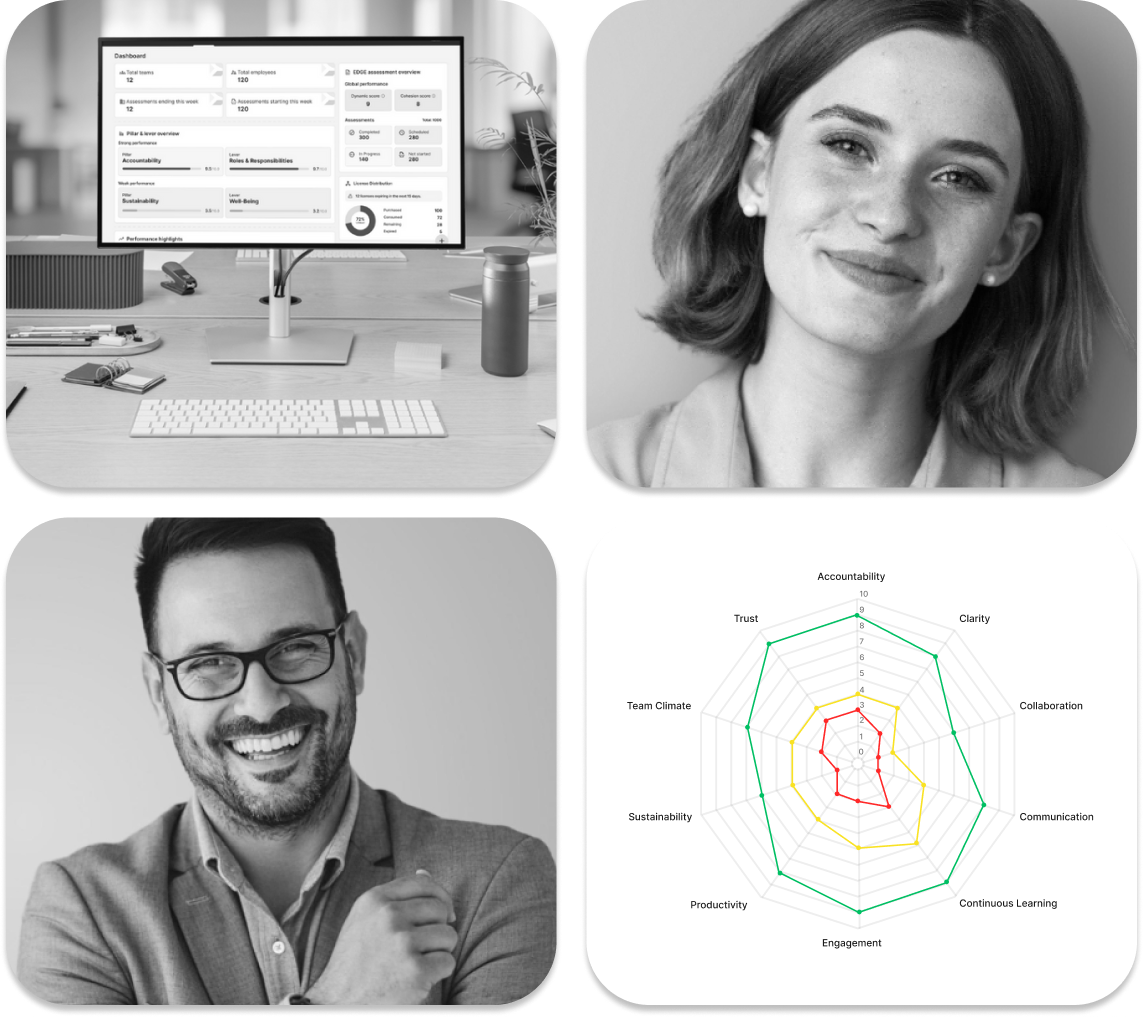
The Grozaic Team Dynamics Assessment brings structure to what is often unseen. It evaluates how teams are functioning across ten interconnected performance pillars, including accountability, clarity, collaboration, communication, continuous learning, engagement, productivity, sustainability, team climate, and trust.
Rather than waiting for outcomes to signal success or failure, it provides visibility into the daily dynamics shaping those outcomes.
This allows leaders to make adjustments early, strengthen alignment, and embed continuous improvement into how the team operates.
Just as elite athletes refine their technique long before competition day, high-performing teams refine their dynamics long before results are visible.
The Real Engine of Growth
Greatness, whether on the field or in the office, is rarely the result of a single moment. It is built through disciplined repetition, structured feedback, and deliberate refinement.
Organizations that focus only on outcomes will always be reacting.
Organizations that focus on how performance is built will consistently outperform.
The unseen grind is not glamorous. But it is where sustainable growth is created.
And when the process is strengthened, the results follow.