

Why Traditional Engagement Surveys Aren’t Enough

For years, employee engagement surveys have been the default mechanism for understanding workplace health. Organizations measure sentiment, track morale, and benchmark engagement scores year over year.
Yet many leadership teams find themselves in a familiar position. The engagement results are “acceptable.” The scores may even trend upward. And still, performance feels uneven. Decisions stall. Friction surfaces in meetings. Accountability feels inconsistent. Energy fluctuates.
The disconnect is not accidental.
Engagement surveys measure how people feel about their experience. They do not measure how the team actually functions.
That distinction matters.
Engagement data is typically aggregated across departments, levels, or the entire organization. The results are averaged, themes are extracted, and broad recommendations are developed. Leaders are then encouraged to implement general initiatives aimed at improving morale or communication.
The problem is that aggregated sentiment produces generalized solutions.
And generalized solutions rarely solve the specific, day-to-day dynamics that drive or drain performance inside a team.
A team may report feeling moderately satisfied overall while still struggling with unclear decision rights. Another may express positive views of leadership yet quietly rely on one dominant voice for all final calls. A third may feel “engaged” but lack real ownership and peer accountability.
When results are averaged, these nuances disappear.
The lived experience of the team becomes diluted into a headline score.
Performance, however, does not live in averages. It lives in patterns.
It lives in how clearly roles are defined.
It lives in how decisions are made.
It lives in how conflict is handled.
It lives in whether commitments are consistently honored.
It lives in whether accountability is shared or concentrated.
These patterns determine whether strategy translates into execution.
Engagement surveys often tell leaders that something feels off. They rarely reveal where the structural friction exists or how relational dynamics are influencing output. By the time action plans are rolled out, they tend to focus on broad cultural themes rather than the precise operational and behavioral shifts required within a specific team.
This is where measurement must evolve.
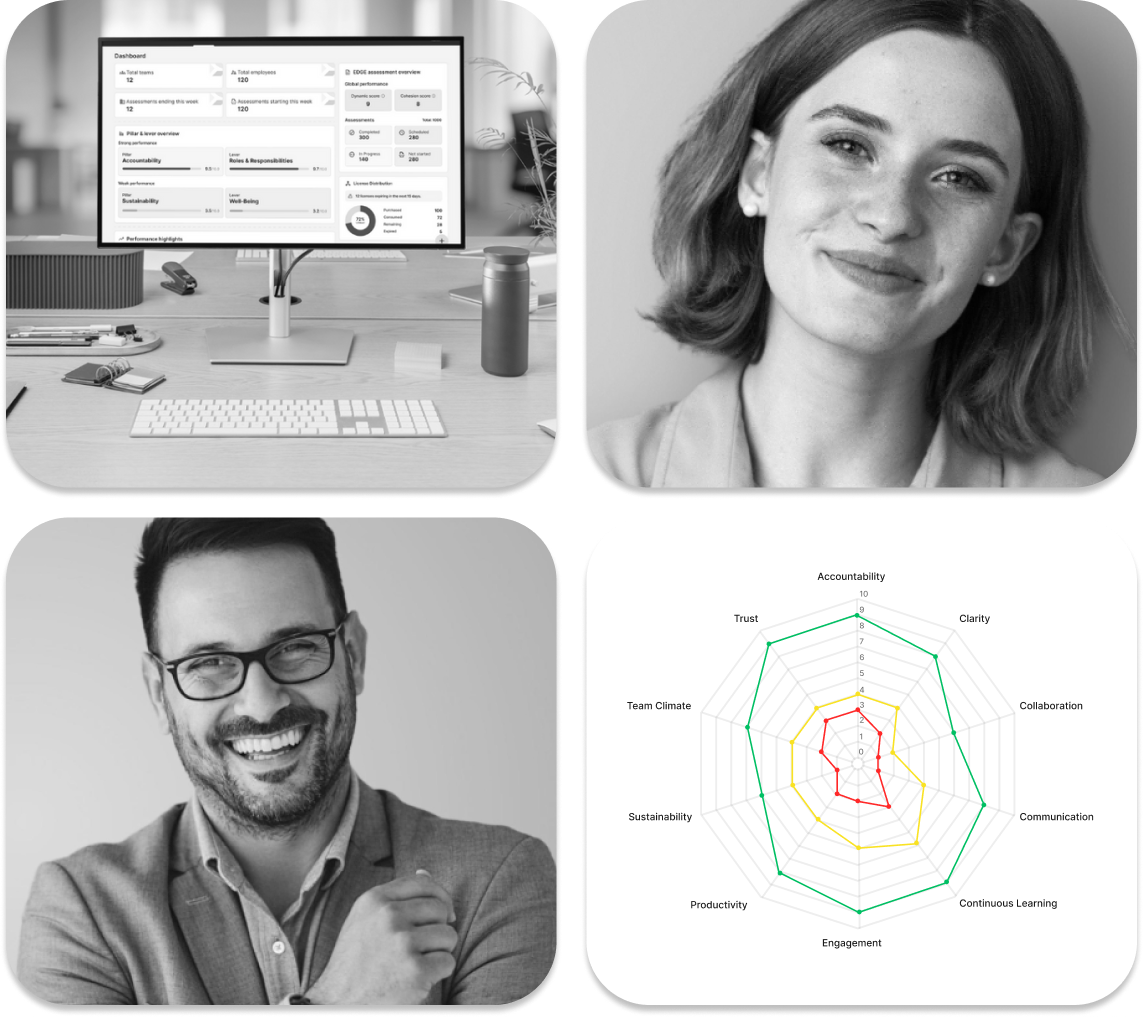
The Grozaic Team Dynamics Assessment was designed to move beyond sentiment and into structure. Rather than asking only how people feel, it examines how a team operates across ten interconnected performance pillars, including accountability, clarity, collaboration, communication, continuous learning, engagement, productivity, sustainability, team climate, and trust.
The intent is not to generate another generic improvement plan. It is to surface the specific dynamics shaping performance within a particular team, in its current context.
It identifies where clarity is creating momentum or confusion. It reveals whether accountability is embedded across the team or flowing upward toward the leader. It highlights whether trust supports open dialogue or whether caution and silence are shaping conversations. It distinguishes between temporary output and sustainable performance.
This level of specificity changes the conversation.
Instead of launching broad engagement initiatives, leaders can address the actual structural levers influencing execution. Instead of implementing
company-wide solutions that may not apply locally, they can focus on the conditions that matter most to their team.
Engagement matters. But engagement is an outcome, not the engine.
When clarity is strong, accountability is shared, trust is embedded, and communication is precise, engagement tends to rise naturally. When those structural elements are weak, no amount of engagement programming will fully compensate.
The more useful question for leaders is not simply, “How engaged are we?”
It is, “How well are we functioning as a team?”
Because performance does not improve through sentiment alone. It improves when the system that produces results is understood and intentionally strengthened.
That is the shift from measuring mood to engineering performance.